
New Opportunities in Private Markets
2023 marks the next evolution for private markets, characterized by challenges and opportunities. Higher interest rates and a shrinking Federal Reserve balance sheet are lowering liquidity in capital markets, creating financial headwinds across all major asset classes.
In the previous period of stable growth and low macroeconomic uncertainty, investors could ride the private markets beta wave without seriously testing their assumptions about liquidity management, portfolio construction, and manager selection. As a more challenging landscape emerges, investors need to consider new ideas for a new regime in private market investing.
Looking across private markets, we believe there are opportunities in select asset classes that look more attractive today than they have been in more than a decade. Inside this report, we outline the key risks, opportunities, and portfolio implications investors need to know to thrive in the new environment.

2023 Private Markets Outlook Full Report
Learn about the evolving private markets landscape, detailed asset class outlooks, and the technological trends driving the next generation of investment opportunities.
Private equity: Paused, awaiting a reset
The private equity (PE) market reached an inflection point in 2022 as the idyllic era of declining interest rates and ever-growing valuations came to an end. PE exit activity dropped sharply in 2022, hindered by macroeconomic headwinds which are likely to persist in 2023. At the end of 2022, the exit-to-investment ratio stood at less than 0.40x, the lowest figure since the global financial crisis.
The slowing exit environment is creating a real sense of differentiation among PE fund portfolios. Within industries, quality was sometimes overlooked, and entire industries experienced “zero gravity” when it came to their valuations. Lower tier companies were being valued at lofty levels similar to top tier companies, even though it would take years for them to grow into their multiples. 2023 will begin to test those valuations.
Investment implications
We believe exits will remain low in 2023, potentially leading to a real reset in valuations. Lower tier companies in their industries are likely to see the largest reductions, while top tier industry leaders that are well-managed and well-capitalized should weather the storm better.
PE secondaries: No longer niche
It appears that 2023 will be a pivotal year for private equity allocators to take advantage of the growing secondaries market. Today, secondaries markets have evolved and deepened substantially with more than US$100 billion in estimated volume in 2022 alone.1 This emerging marketplace provides an alternative to investing purely in primary fundraises.
2023 presents a significant shift in the supply-demand dynamics of secondaries markets. Leading up to 2022, deal volumes were dominated by GP-led transactions (mainly in the form of continuation funds and single asset deals) and discounts for LP portfolios were in the single digits. In 2022, the average discount on secondaries was around 19%, the deepest average discount in more than seven years.
Looking ahead, several factors are poised to favor buyers of secondaries, including low levels of dry powder on the sidelines and more LPs seeking liquidity as they reconfigure their private capital allocations.
Investment implications
We are seeing a lopsided secondaries market that will likely heavily favor investors on the buying side of the negotiating table. From a risk/reward perspective, we believe 2023 will be a year to remember for secondary market opportunities.
Private debt: Hardwired for hard times
Just a year ago, private debt was maligned with a number of factors that presented an uninspiring risk/return profile, including tight spreads to public debt, “covenant-lite” loans, and substantial competition for deals. Yet, investors continued making allocations given the lack of yield available elsewhere.
Today, the asset class presents a far different picture and shows how this segment is essentially “hardwired” for a rising rate, risk-off market environment where traditional financing is shutdown. Now, private lenders have much greater negotiating power and can extract a complexity premium and build in better default protections. Tough economic environments may lead to greater dispersion in manager returns—challenging the idea that the direct lending space has become commoditized.
Furthermore, there is now a much larger opportunity set in distressed debt because tighter financial conditions have limited corporate flexibility. As a result, good businesses that have made mistakes can become stressed, providing very attractive opportunities for special situations investors.
Investment implications
Direct lenders with experienced workout teams and solutions-based approaches are ready to combat higher default risks. At the same time, there is an opportunity set explosion within the distressed space with more and more “good company, bad balance sheet” investments offering attractive potential returns.
Commercial real estate: Remodeling for rising rates
The combination of higher inflation and rising interest rates will likely have a material yet varied impact on the US commercial real estate market in 2023. Higher financing costs along with tighter lending standards have added some upward pressure on capitalization rates and downward pressure on property values.
There are, however, still significant positive tailwinds. Consumer spending, labor markets, business activity, and corporate balance sheets have all continued to be relatively healthy. While every real estate downturn has its own unique dynamics, historically, US private real estate investment performance has been strong during periods of rising yields, as well as during the 12 to 18 months thereafter.
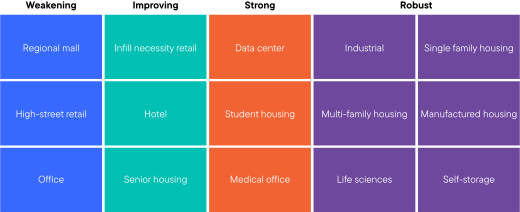
But real estate portfolios need a remodel. Post-pandemic trends like remote work, e-commerce growth, and the migration of people to non-traditional urban business centers are reshuffling property markets. While some property sectors, such as office and mall, have not fully recovered from the pandemic impacts, other property sectors have reported sizable ongoing rent growth, including industrial, apartment, life sciences, and self-storage.
Trends like remote work and e-commerce are reshuffling sector leadership
US real estate fundamentals and pricing power by property sector
Source: Clarion Partners Investment Research, views as of December 2022. Subject to change.
Investment implications
As the market leaders and laggards reshuffle, higher inflation and rising interest rates will have material yet varied impacts on US private real estate. Opportunistic investors may be able to acquire high-quality assets at a discount—and at scale—in sectors with secular tailwinds.

2023 Private Markets Outlook
Learn about the evolving private markets landscape, detailed asset class outlooks, and the technological trends driving the next generation of investment opportunities.
Contact Us
Contact us if you would like to speak to one of our relationship managers or consultant advisors.
Footnotes
1. Source: Jefferies Global Secondary Market Review. As of January 2023.
Important Legal Information
This material is intended to be of general interest only and should not be construed as individual investment advice or a recommendation or solicitation to buy, sell or hold any security or to adopt any investment strategy. All investments involve risks, including possible loss of principal. There is no guarantee that a strategy will meet its objective. Performance may also be affected by currency fluctuations. Reduced liquidity may have a negative impact on the price of the assets. Currency fluctuations may affect the value of overseas investments. Where a strategy invests in emerging markets, the risks can be greater than in developed markets. Where a strategy invests in derivative instruments, this entails specific risks that may increase the risk profile of the strategy. Where a strategy invests in a specific sector or geographical area, the returns may be more volatile than a more diversified strategy.
This site is intended only for APAC Institutional Investors and Consultants. Using it means you agree to our Anti-Corruption Policy.
If you would like information on Franklin Templeton’s retail mutual funds, please visit https://www.franklintempleton.com/corporate to be directed to your local Franklin Templeton website.
