
Our Franklin Templeton 2019 Retirement Income Strategies and Expectations (RISE) survey suggests people in Hong Kong SAR and mainland China are becoming more aware of the looming retirement funding gap, driven by increased longevity and dwindling investment returns. In this paper, we look at how the retirement industry could overhaul the outdated “one-size-fits-all” approach to retirement investing through the introduction of innovative products and services that fit in line with the rest of the financial world.
Expectations vs. Reality in a Changing Retirement Landscape
Health care advancements are prolonging global lifespans in Hong Kong and China. While this is welcome news, it poses a conundrum for the financial services industry, according to our Franklin Templeton RISE survey. Traditional investment strategies to meet retirement goals are no longer as effective as they used to be in decades past. Our experience tells us there needs to be more innovative solutions to provide potential diversification1 against a backdrop of heightened market volatility, weakening global economic growth,2 lower (and in some cases negative) interest rates, and therefore in many cases, lower investment returns.
However, many respondents to our RISE survey are becoming aware of the difference between what they’ve saved and what they expect to spend, known as the “savings gap”. The issue of potentially outliving their pension is felt in China where the savings gap is growing by 7% a year.3
We think there is a significant opportunity for Hong Kong’s financial services industry to shrink the savings gap using a two-pronged approach: better, and more widely-available retirement advice—while managing reasonable investment expectations—and, the introduction of innovative products and services that are in line with offerings in the rest of the financial world.
One Size Doesn’t Fit All
We see a general shift in the expectations across the spectrum of retirement clients—there’s no longer a single solution for retirement income.
The three factors to retirement investment—planning, investment and delivery—have changed over time to reflect new client goals we see in Hong Kong and China. In the past the retirement portfolios were simply required to “beat the benchmark” or “weather volatility”. Now we’re seeing increased investor appetite for portfolios that are personalized, dynamic and probability driven. For example, attitude to risk varies between the beginning, middle and end of a retirement savings journey. Dynamic programming, where multiple decisions are made by algorithms, can assist in analysis and investment selection, and allow risk to be tailored.
Changing Landscape to Savings and Pension Delivery
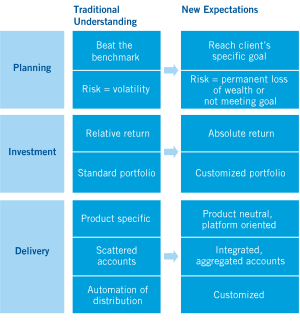
Source: Franklin Templeton, for illustrative purposes only.
The overall shift in attitudes toward retirement investing is reflective of the changes we’ve seen in the ways people in Hong Kong contribute to their retirement funds. “Gold-plated” defined benefit (DB) schemes, now widely considered a rarity, have been largely taken over by defined contribution (DC) schemes, operated through Hong Kong’s Mandatory Provident Fund (MPF) scheme,4 which mainly offers investments in bonds and multi-asset funds.
Our experience suggests many pension fund managers are looking to diversify away from a reliance on traditional assets, such as bonds and multi-asset funds. Instead, they want to incorporate non-traditional exposures, such as illiquid assets including private equities, real estate, hedge funds, and certain types of direct debt instruments.
Determining the premium in illiquid assets can be a thorny issue. There are a lot of operational issues to tackle, from day-to-day pricing to fair valuations, given the asset class tends to have lower volumes of trading. However, over a long investment horizon illiquid assets can offer diversified exposure to investment portfolios that can’t be accessed through traditional listed equities and bonds.5
We would caution that illiquid assets aren’t right for all investors, and a careful consideration of age, risk-tolerance and goals is needed. But we believe it might be necessary for some investors with a high-risk tolerance and ambitious goals to “think outside the box,” as it may be tough to reach their return expectations with traditional, low-yielding fixed income products. One of the key takeaways from our survey is that people in Hong Kong may need a more sophisticated approach to bolster their investments, given that savings made up 77% of respondents’ source of retirement income. We think there’s an opportunity for pension funds to offer innovative solutions to select investors.
Many Investors Have Broadened Exposure to Economic Growth in Search of Better Returns
Allocation of Equities & Alternatives vs. Fixed Income and Cash in Public Pensions (1954 to 2017)
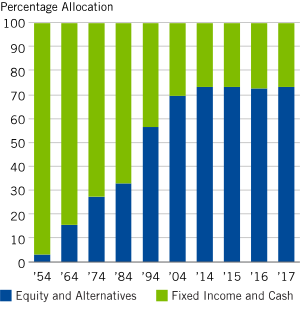
Sources: Calculations by the Franklin Templeton Capital Market Insights Group using data sourced from the US Board of Governors of the Federal Reserve System, Financial Accounts of the United States, and Pew Analysis of State Financial Reports. Not all alternative investments are equity-like. Alternative assets do not fall into one of the conventional categories such as stocks, bonds or cash.
Solutions Are Evolving
“Beta” has traditionally been a measure of the volatility of a security or portfolio in comparison to the stock market as a whole. It is also used to describe getting broad stock market exposure, typically through investments that track a major benchmark index.
“Smart beta” refers to a methodology of index construction that seeks to achieve risk-adjusted returns that are better than traditional, market capitalizationweighted benchmark indexes, through the use of specific “factors,” or drivers of performance.
Another approach that seems to be gaining traction in the Hong Kong and mainland China retirement sector is smart beta. In our view, smart beta is no longer a “niche” investment strategy and is making its way into the mainstream.
Smart beta has a role to play in helping clients achieve their goals. As smart beta pioneers who introduced an equity smart beta strategy to Hong Kong’s MPF scheme in late 2017, we’re excited about the possibilities this could bring to the local retirement market.
We’d consider smart beta, or multi-factor investing, to be an additive investment strategy that follows a set of rules according to factors such as quality, value, momentum and volatility to achieve a specific outcome.6 Smart beta is slowly taking off in Hong Kong for those with a long-term view that fits in line with retirement investing.
Future of the Retirement Space
We’re seeing a transformation in the retirement space. We’d expect the way individuals interact with solution providers to change; for example, the prospect of managing retirement savings through mobile phone apps could soon become a reality. In the last year, the Hong Kong Monetary Authority (HKMA) has announced eight new virtual banking licenses that will be operated online only, forgoing an institution’s traditional brick and mortar presence. With high smartphone usage in Asia, we believe more app-based retirement management could encourage more people to take control of retirement investments. That in turn could help solve the broader savings gap.
In the same way, we think there will be a general shift in demand towards continuous income-related assets. The governmentbacked lifetime annuity plan that launched in 2018—providing a monthly income stream after paying a single premium—could gain popularity as it taps into the “Asian mindset” of receiving a regular income. This public annuity plan reflects the ongoing shift to income-related assets. Annuities already make up a large proportion of retirement income in Australia, the United States and the United Kingdom.
Conclusion
Our RISE survey has shown us that many individuals may need to think outside the box to meet their retirement goals. A potential resolution to closing the retirement funding gap requires both financial institutions and the government to meet halfway. A general improvement in retirement education, in addition to seeing more creative and innovative products in the market could drive home the message that people need to be financially prepared for retirement. And, the prospect of managing retirement savings through mobile phone apps could help spread this message. We think the bigger picture is that our industry needs to put in as much effort developing new and innovative financial products as it does encourage retirement investing, regardless of age.
About the Survey
The Franklin Templeton Retirement Income Strategies and Expectations (RISE) survey was conducted online with a sample of 1,037 adults in Hong Kong, comprising 514 men and 523 women, and 1,114 adults in China with 583 men and 531 women. The target respondents were employed, aged 25 or above with a personal monthly income of HKD12,000 or above in Hong Kong and RMB5,000 or above in China. The survey was administered between April 16, 2019 and May 2, 2019 by the Nielsen Company (Hong Kong) Limited, which is not affiliated with Franklin Templeton.
ENDNOTES
-
Diversification does not guarantee profits or protect against risk of loss.
-
The World Bank predicts global economic growth to slow to 2.6% for 2019, June 2019 Global Economic Prospects report.
-
World Economic Forum, May 2017.
-
Employees and employers are required to make monthly payments to the Mandatory Provident Fund (MPF), a compulsory pension fund for Hong Kong residents.
-
Diversification does not guarantee profits or protect against risk of loss.
-
Smart beta refers to a methodology of index construction that seeks to achieve better risk-adjusted returns compared to traditional market capitalization weighted benchmark indexes.