

CONTRIBUTORS

Chuck Royce
Chairman, Portfolio Manager

Francis Gannon
Co-Chief Investment Officer, Managing Director
Were you surprised by how well the Russell 2000 Index rebounded in 4Q23?
Chuck Royce: We were surprised to some degree, yes. On the one hand, we had been waiting for a meaningful small-cap rebound for some time and really felt as though it was long overdue by the time the fourth quarter rolled around. We’ve also been showing data over the last few years which highlights how undervalued the Russell 2000 Index is relative to the large-cap Russell 1000 Index—even at the end of 2023, small-caps were still trading close to their 20 year lows based on a valuation metric that we often use, the last 12 months of enterprise value (EV) to earnings before interest and taxes (EV/EBIT). In addition, we thought that the Federal Reserve’s (Fed) decision to pause rate hikes would spur an increase in stock prices. Based on all of that, the 14.0% 4Q23 advance for the Russell 2000 was not a surprise. But in light of how dominant large- and mega-cap stocks have been over the last several years—and how stubbornly they’ve clung to leadership—it was very satisfying to see the Russell 2000 beat both the Russell 1000 and Russell Top 50 in 4Q23.
What other factors were notable about the performance of small-caps in 4Q23?
Francis Gannon: First, we were pleased to see small-cap value beat small-cap growth in the fourth quarter: the Russell 2000 Value Index was up 15.3% versus a 12.7% gain for the Russell 2000 Growth Index. A similar dynamic to the one that Chuck mentioned regarding valuations between small- and large-cap can also be seen in the relative valuations of small-cap value and small-cap growth. Based on that same EV/EBIT metric, the Russell 2000 Value was trading at much lower valuations at the end of 2023 compared to the Russell 2000 Growth.
What do you see as the implications for these cheaper relative valuations for small-cap and small-cap value going forward?
Francis Gannon: I think the critical factor is how much running room small-cap stocks have on both an absolute and relative basis. Consider that, even after its very bullish fourth quarter, the Russell 2000 underperformed the Russell 1000 in 2023 by a wide margin, up 16.9% versus 26.5%. Similarly, the Russell 2000 Value gained 14.6% versus 18.7% for the Russell 2000 Growth in 2023. Moreover, the Russell 2000 finished the year -14.3% shy of its prior peak on 11/8/21, while large-caps continued to make new highs into the end of December 2023.
Small-Caps Lagged Large-Caps from the Russell 2000’s Last Peak
Russell 2000 and Russell 1000 Cumulative Returns
11/8/21-12/31/23
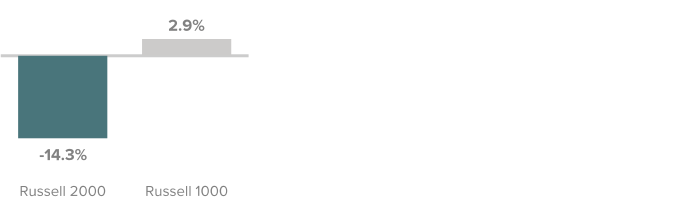
Source: Russell Investments. Past performance is no guarantee of future results.
In addition, 45% of the companies in the Rusell 2000 remained down -20.0% or more as of 12/31/23. This tells us that terrific long-term opportunities can still be found—in particular for attractively undervalued and/or high-quality companies with strong fundamentals and promising long-term growth prospects, which are exactly the kinds of businesses we look for in our major domestic strategies.
Chuck Royce: I think it’s also worth noting that the Russell Microcap looks, if anything, even cheaper based on EV/EBIT—which really reinforces Frank’s point about the long-term opportunities' patient investors can source within the small- and micro-cap asset classes. Both are much broader and more diverse than large-cap—and receive far less analyst coverage. This lack of institutional attention creates challenges—but these same obstacles have often given us—and our investors—rewards over the long run.
Do you see small-cap overtaking large-cap at some point?
Francis Gannon: Yes—though we obviously don’t know when. When we look at long-term performance patterns, small-cap had a longstanding advantage—just as small-cap value did versus small-cap growth. Each of these dynamics began to shift in the aftermath of the Financial Crisis, starting in earnest in 2011. In nine of the last 13 years, the Russell 1000 and Russell 2000 Growth beat both the Russell 2000 and Russell 2000 Value. Yet prior to that, the long-term edge was with the Russell 2000 and Russell 2000 Value. What we think many investors may have forgotten is how anomalous the backdrop to the last 13 years has been—with mostly anemic economic growth and record low interest rates. Now that these elements are returning to more historically typical levels, we expect to see some meaningful long-term mean reversion going forward.
Do you think a more historically normal level of rates can help high-quality small-caps going forward?
Chuck Royce: First, I think a more historically normal level of rates ultimately helps a lot of stocks, if only from the standpoint of stability. Companies fear uncertainty and instability more than almost any other factors, so I think the end of the Fed rate hike cycle should be viewed as a positive for most equities other than the most highly levered businesses. Of course, this has as much if not more to do with the end of the fastest rate of increase in history as it does with where rates are currently sitting. But in any event, I think that companies with low leverage, the ability to generate free cash flow, and proven capital allocation skills are poised to benefit most. And it’s true that we find those attributes most frequently in the small-cap quality zone—that is, companies that also have high and consistent returns on invested capital, discernible competitive advantages, and a sustainable franchise.
Francis Gannon: The price of carrying leverage on the balance sheet began to climb when the Fed first started raising rates in March of 2022. I don’t think we can stress how important low leverage is—especially now that we’re in a more historically normal interest rate environment. Of course, we’ve always focused on small-cap companies with low or no leverage, though we accept that the era of zero or ultra-low rates made the issue of leverage less important for many companies and investors. But we are no longer in that environment—and we anticipate that investors will begin to reward well-managed companies with low-debt balance sheets more regularly.
What investment themes or industries within small-cap look most promising to you as a long-term investor?
Chuck Royce: As always, we look carefully at almost every sector and industry in our efforts to find high quality and/or attractively undervalued small-cap companies. Some areas yield more ideas than others, of course, and we continue to lean toward more cyclical sectors. I think the most prominent themes in the portfolios I work on remain high quality and companies involved in automation or other innovations that provide other businesses with the tools and services that improve efficiency and productivity. In fact, many of these companies were utilizing AI for years before we all began talking about ChatGPT.
What is your outlook?
Francis Gannon: Our outlook is constructive. First, we suspect that returns are likely to skew more widely over the next few years and that the reign of the Magnificent 7 (M7) may be coming to an end, especially if 2023’s fourth quarter and early January 2024 are any indication. The backdrop of moderating inflation, normalized interest rates, and a still growing U.S. economy, also bolsters our belief that small-cap’s lengthy stretch in the relative performance wilderness has run its course. Moderate economic growth and the more normalized rate environment should support a broadening of equity market returns where small-caps could be clear beneficiaries, especially those businesses that have largely sat out the mega-cap performance regime. In addition, large-cap cycles have historically peaked when a relatively small number of the largest stocks were winning the lion’s share of performance. We saw this with the S&P 500 in 1973 and in March 2000. Furthermore, a few of the M7 will continue to face the possibility of greater regulation, especially from Europe.
Chuck Royce: Of course, we always put the most stock in what we’re hearing from management teams—most of whom remain cautiously optimistic about 2024. It appears increasingly likely, for example, that the U.S. economy will achieve the much-desired soft landing—which is encouraging for many reasons. The next few years will see even more tangible benefits of reshoring, the CHIPS Act, and numerous infrastructure projects, and many of our holdings are poised to benefit from these developments. So, we’re looking forward to what we think should be a favorable cycle for small-cap stocks.
Definitions
The Russell 1000 Index is an unmanaged, capitalization-weighted index of domestic large-cap stocks. It measures the performance of the 1,000 largest publicly traded US companies in the Russell 3000 Index.
The Russell 2000 Index is an index of domestic small-cap stocks that measures the performance of the 2,000 smallest publicly traded US companies in the Russell 3000 Index.
The Russell 2000 Value and Growth indexes consist of the respective value and growth stocks within the Russell 2000 as determined by Russell Investments.
The Russell Top 50 Mega Cap Index is a market-capitalization-weighted index of the 50 largest stocks in the broad-based Russell 3000 universe of US-based equities.
The Russell Microcap Index measures the performance of the microcap segment of the US equity market.
The S&P 500 Index is an unmanaged index of 500 stocks that is generally representative of the performance of larger companies in the US.
Enterprise value (EV) refers to the entire value of a company after taking into account both holders of debt and equity.
The EV/EBIT multiple is the ratio between enterprise value (EV) and earnings before interest and taxes (EBIT).
The CHIPS and Science Act (CHIPS Act) is a US federal statute enacted by the 117th United States Congress and signed into law by US President Joe Biden on August 9, 2022. The act provides roughly $280 billion in new funding to boost domestic research and manufacturing of semiconductors in the United States.
The Federal Reserve Board (Fed) is responsible for the formulation of US policies designed to promote economic growth, full employment, stable prices, and a sustainable pattern of international trade and payments.
The Magnificent Seven stocks are Amazon.com (AMZN), Apple (AAPL), Google parent Alphabet (GOOGL), Meta Platforms (META), Microsoft (MSFT), Nvidia (NVDA) and Tesla (TSLA).
WHAT ARE THE RISKS?
All investments involve risks, including possible loss of principal. Past performance is no guarantee of future results. Please note that an investor cannot invest directly in an index. Unmanaged index returns do not reflect any fees, expenses or sales charges.
Equity securities are subject to price fluctuation and possible loss of principal.
Small- and mid-cap stocks involve greater risks and volatility than large-cap stocks.
Fixed-income securities involve interest rate, credit, inflation and reinvestment risks; and possible loss of principal. As interest rates rise, the value of fixed income securities falls.
International investments are subject to special risks including currency fluctuations, social, economic and political uncertainties, which could increase volatility. These risks are magnified in emerging markets.
Commodities and currencies contain heightened risk that include market, political, regulatory, and natural conditions and may not be suitable for all investors.
US Treasuries are direct debt obligations issued and backed by the “full faith and credit” of the US government. The US government guarantees the principal and interest payments on US Treasuries when the securities are held to maturity. Unlike US Treasuries, debt securities issued by the federal agencies and instrumentalities and related investments may or may not be backed by the full faith and credit of the US government. Even when the US government guarantees principal and interest payments on securities, this guarantee does not apply to losses resulting from declines in the market value of these securities.
Any companies and/or case studies referenced herein are used solely for illustrative purposes; any investment may or may not be currently held by any portfolio advised by Franklin Templeton. The information provided is not a recommendation or individual investment advice for any particular security, strategy, or investment product and is not an indication of the trading intent of any Franklin Templeton managed portfolio. Past performance does not guarantee future results.
Data and figures quoted in this article sourced from Russell Investments, Bloomberg and Reuters.