

CONTRIBUTORS

Francis Gannon
Co-Chief Investment Officer, Managing Director, Royce Investment Partners

Chris Clark
Chief Executive Officer, Co-Chief Investment Officer & President, RFS
How a year of uncertainty became a year of double-digit returns
In July of last year, we observed that the year’s first six months had given investors nearly every kind of investment weather. The second half of the year proved equally eventful, with two significant differences. First was the long-awaited absolute and relative strength of small- and micro-cap stocks following the market’s bottom in spring of 2025. Second was the related fact that investors were far more at ease with uncertainty in the last three quarters of the year than at the beginning of the year.
The onset of 2025 saw tariff talk (as well as a volatility inducing “now you see it, now you don’t” approach to implementation), stubborn inflation, declining consumer confidence, and a consequent revival of recession fears, all of which worked to keep stocks underwater in 1Q25. The markets then fell even further (and faster) following “Liberation Day” on 4/2/25, in which US President Trump announced a broad set of tariffs and other changes to trade policy. So, while the president characterized these moves as a return to “economic sovereignty,” investors disagreed. There is almost nothing markets hate more than uncertainty, and the first few months of 2025 offered more than the usual amount.
Among the most interesting developments in the year, then, was how quickly and easily investors changed course as they were soon taking advantage of the opportunities bred by the tariff-induced downturn. Equities quickly recovered after bottoming on 4/8 in spite of a long list of uncertainties and challenges, including ongoing conflict in Ukraine and Gaza, persistent (though moderate) inflation, a declining US dollar, slowly rising unemployment, and a lack of confidence among US consumers. To this list, we can add newer, potentially troublesome developments in Iran, Venezuela, and (of all places) Greenland, as well as the fractious relationship between the Trump administration and Federal Reserve (Fed) Chair Jerome Powell, whose tenure is ending later this year in May, when he is likely to be succeeded by Kevin Warsh.
Micro-caps reach the peak of a resilient market
In this challenging context, the equity markets showed remarkable resilience, perhaps because, at the same time, the US economy remains solid, unemployment is low, oil is cheap, and the Fed cut interest rates three times last year (which also lowered mortgage rates). Following April’s bottom, investors were happy to weigh positive developments more heavily than the uncertainties. Looking at the VIX—the CBOE S&P 500 Volatility Index, often referred to as the ‘fear gauge,’ which measures the S&P 500’s expected 30-day volatility—shows a sharp increase near the end of 1Q25 that then subsided through the rest of the year. Throughout the last nine months of 2025, the market remained uncommonly placid, with the VIX sitting lower than its long-term historical average of 30. It merely approached, though never reached, that level in brief spurts during October and November when the artificial intelligence (AI) trade showed signs of unwinding. (It has also crept upward at times in the first few weeks of 2026.)
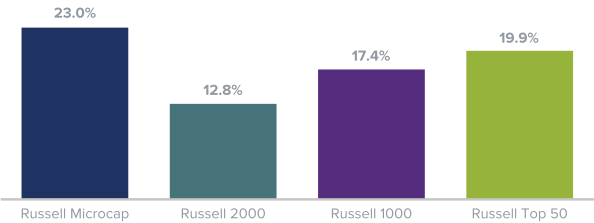
The upshot was a terrific year for the major US indexes, though the big winner might come as a surprise to some. The Russell Microcap Index led the way, while small-caps trailed large- and mega-cap stocks (thanks in large part to a dismal first quarter for the small-cap Russell 2000 Index). For 2025 as a whole, the Russell Microcap was up 23.0%, the Russell 2000 gained 12.8%, the large-cap Russell 1000 Index rose 17.4%, and the mega-cap Russell Top 50 Index increased 19.9%. The calendar-year spread between the small- and micro-cap indexes was the third widest since the latter index’s inception in 2000. (Results for non-US stocks, which have finished behind their stateside peers over the last several years, were also notable in 2025, with the MSCI ACWI ex-USA Small Cap Index advancing 29.3% and the MSCI ACWI ex-USA Large Cap Index gaining 32.5%.)
An Impressive Year for Stocks of All Sizes
Russell Index Returns, 12/31/24-12/31/25
Source: Russell Investments. Past performance is no guarantee of future results.
The question that this article seeks to answer, of course, is how and when might small-caps join their micro-cap siblings at the market’s performance summit? January 2026 offered a pattern that we think can be sustained, as the small- and micro-cap indexes finished the month well ahead of their large- and meg-cap eqivalents.
AI: Coming soon to a small-cap company near you?
One path involves shifts in terms of which companies appear likely to benefit from the AI revolution in 2026. To quote Mark Twain (as well as to echo how most of our investment teams view their technology investments), “During the gold rush, it’s a good time to be in the pick and shovel business.” The Magnificent 7 group of mega-cap companies has been generating headlines almost every day about the billions of dollars they or their ecosystem partners have raised to fund continued investment in AI models, computing power, data center capacity, etc.
We believe in companies that are already been reaping the benefits of this spending since they provide differentiated products or services that are key enablers of AI’s evolution and the buildout of AI-related infrastructure. These companies are supplying many of the tools, components, and services to their bigger peers, including semiconductor components that enable various AI applications, energy providers crucial to the functioning of data centers, and the construction companies that are building them. A few examples include:
- A duopoly provider of advanced probe cards that are essential for testing complex high bandwidth memory chips and GPUs.
- A critical infrastructure products producer that is a dominant provider of the highly engineered utility structures needed for utilities to harden their grids and expand higher voltage transmission in the face of rising load growth (in part from AI data centers).
- A specialty infrastructure services provider that is the scale player in site preparation for data centers and semiconductor fabs.
- A premier engineering and consulting firm that brings domain expertise to clients incorporating machine learning and AI into their systems and products, while also helping to address potential challenges and disputes that may arise.
In something of a paradox, then, smaller companies that are helping mega-cap players are getting on investors’ radar just as we are beginning to see a so far gradual unwinding of the AI trade, which is lowering share prices for certain mega-cap companies.
There is another set of small-cap companies that are using AI to drive innovation, productivity, and/or efficiency. We anticipate a more pronounced shift away from some of the mega-cap companies that provide AI to the many companies that can commercialize AI applications to grow their businesses and/or companies that will see margin improvement by leveraging AI tools. Active management will likely be critical in sourcing the smaller companies that stand to do best in what is shaping up to be a vigorous, though at times highly volatile, market this year (as a few sessions in early January have shown). There are also a number of consulting companies and software businesses that have been virtually left for dead. However, our conversations with management teams and further research and analysis suggests these companies should actually benefit from AI and are likely to see improved profitability in the years ahead. We’ve seen a similar dynamic before within small-cap, where pockets of the market have been beaten down before other investors realize that these companies are well positioned to benefit from a new technology, leading the stocks to rebound nicely.
Small-cap opportunities beyond AI
Of course, our investment teams see many opportunities in areas that lie outside AI, including businesses in the consumer discretionary and consumer staples sectors. There have also been interesting opportunities in health care beyond the biopharma complex, which dominated small-cap performance in 2025. Elsewhere, they have been investing in industries such as packaging, business services, and insurance, all of which appear poised to do well in 2026. Green shoots can be seen in the non-AI parts of the semiconductor chain, along with companies involved in manufacturing, where industrial distributors, to take one example, are starting to experience stabilization at the bottom of the business cycle. Opportunities have also been found in diverse areas such as commercial and professional services, transportation, and capital markets.
Even as many small- and micro-cap companies have done well over the last nine months, the breadth and depth of the universe—in addition to the much lower level of analyst coverage—help make our selection universe an evergreen source of investable ideas.
Revenge of the forgotten asset classes?
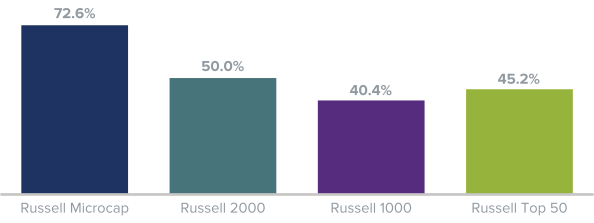
After more than a decade of underperformance, we have taken to referring to small-cap as “the forgotten asset class.” If that is the case, then micro-caps would qualify as the really forgotten asset class. Thus far in 2026, for example, the financial media has paid almost no attention to the extraordinary run for micro-caps last year. Also receiving very little attention has been how well both small- and micro-caps performed from the April 2025 bottom into January of 2026. From 4/8/25-1/30/26, the Russell Microcap gained 72.6%, the Russell 2000 advanced 50.0%, the Russell 1000 was up 40.4%, and the Russell Top 50 advanced 45.2%.
Small- and Micro-Cap’s Impressive Runs Off the April Market Low
Russell Index Returns, 4/8/25-1/30/26
Source: Russell Investments. Past performance is no guarantee of future results.
We are confident that this run can continue. After years of false starts, head fakes, and rallies that began with promise only to end with small- and micro-cap stocks trailing their larger counterparts, we understand—and share—the frustration that comes with extended periods of underperformance. First, it’s important to keep in mind that 2025’s returns, particularly off the April lows, were driven primarily by lower quality, speculative stocks, along with anything with an obvious connection to the AI boom. Low quality small-cap cycles tend to average about 12 months, suggesting that a regime shift is likely in the next few months. Additionally, more of what we would characterize as “traditional” businesses models—those that have healthy margins, generate free cash flow, grow modestly, and have strong, self-funding balance sheets that also trade at attractive valuations—should regain the attention and interest of investors as many of the early phase winners begin to fall back.
With regard to micro-caps specifically, returns for the asset class are often a barometer of risk. To the extent that investors remain comfortable with less liquidity and are willing to take risks, we believe micro-caps should do well. Equally important, there are higher-quality micro-cap companies, and if the market continues to broaden out as we expect, more of these micro-caps should participate as the leadership baton within small-cap as a whole passes from more speculative stocks to more established, quality companies with more proven, durable business models.
Why small-cap, why now
There are additional factors that can have the potential to drive both strong returns and overall market leadership beyond what we have already discussed. For the purposes of this discussion, we include micro-caps within the broad and diverse small-cap universe. First, one of the more interesting elements in the “Big, Beautiful Bill” signed earlier this year is the fact that companies can have 100% depreciation on research and capital expenditure (capex)—which suggests that we could see a robust capex cycle in 2026. Such cycles have typically meant good things for small-cap stocks, though the market has not yet caught on to this. We expect that to change as the year progresses.
We also believe that both small-cap quality and value are poised for meaningful rebounds in 2026. The most likely path to outperformance would be one in which economic growth accelerates, in part driven by stimulus coming from Washington that could help both businesses and consumers, particularly those in the lower half of income distribution. If this occurs, more widespread economic growth would benefit a broader array of industries from banks (thanks to loan growth and healthy credit) to select areas in Industrials (due to onshoring and solid general growth) and consumer discretionary. Previous periods that had more widespread equity returns (in stark contrast to the unprecedented narrow market leadership of the last few years) have seen small-caps beat large-caps most of the time, often by healthy margins. Of course, we are mindful that narratives, as well as fundamentals, can shift quickly and unexpectedly—and we are prepared to capitalize on opportunities regardless of the macroeconomic backdrop.
Do earnings + valuations = sustained small-cap leadership?
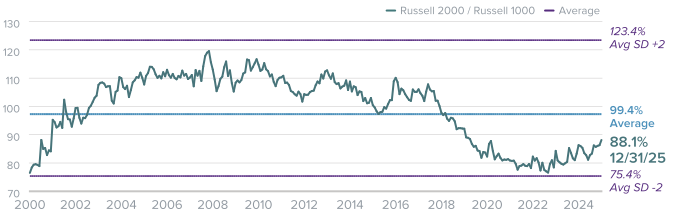
In our view, by far the most compelling case for small-cap leadership in 2026 comes from a relatively rare and promising confluence of factors: Relatively low valuations for small-cap versus large-cap and the forecast for higher earnings for small-cap companies. Even after a year of robust returns, valuations for the Russell 2000 at the end of 2025 were still quite close to their lowest levels versus the Russell 1000 in 25 years, using our preferred index valuation metric of EV/EBIT or enterprise value over earnings before interest and taxes.
Relative Valuations for Small-Caps vs. Large-Caps Remain Near Their Lowest in 25 Years
Russell 2000 vs. Russell 1000 Median LTM EV/EBIT (ex. Negative EBIT Companies), 12/31/00 through 12/31/25
Source: FactSet. Past performance is no guarantee of future results.
But the argument in favor of small-cap leadership is greatly enhanced by the promising earnings picture we see for 2026. We have always subscribed to the adage that psychology runs the market in the short run, but earnings run it in the long run. Earnings for across asset classes were generally positive in 3Q25, with many companies handily beating estimates. Smaller companies, however, generally fared better in terms of earnings growth. Even more encouraging, the research we have seen forecasts accelerated earnings growth for small-cap stocks in 2026. The Fed’s rate cuts provided a boost, while additional catalysts, including possible tariff relief, reshoring, and ongoing infrastructure improvements, chould also help vault small-caps into a sustained leadership role, as can the aforementioned possibility of a healthy capex cycle and the benefits accruing to those small-cap companies that are providing AI’s ‘picks & shovels.’
Small-Cap’s Estimated Earnings Growth is Expected to Be Higher Than Large-Cap’s in 2026
One-Year EPS Growth
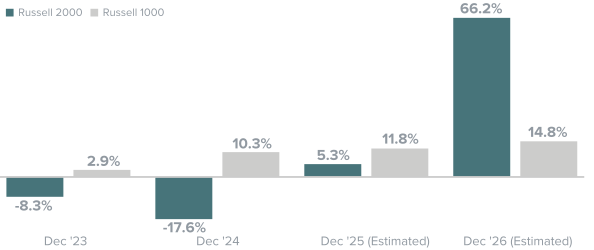
Source: FactSet. Past performance is no guarantee of future results. Earnings per share (EPS) is calculated as a company’s profit divided by the outstanding shares of its common stock. The EPS Growth Estimates are the pre-calculated mean two-year EPS growth rate estimates by brokerage analysts. Estimates are the average of those provided by analysts working for brokerage firms who provide research coverage on each individual security as reported by FactSet. All non-equity securities, investment companies, and companies without brokerage analyst coverage are excluded.
We enter 2026 with ample levels of uncertainty for both the US economy and on the geopolitical front. Yet our investment teams remain confident that small-cap can attain and sustain market leadership. Finally, we want to remind investors that the opportunity still exists to build one’s small-cap allocation at attractive valuations. We continue to see the current period as an opportune time to invest in select small-caps for the long run.
Definitions
The Russell 1000 Index measures the performance of the 1,000 largest companies in the Russell 3000 Index, which represents approximately 92% of the total market capitalization of the Russell 3000 Index.
The Russell 2000 Index is an index of domestic small-cap stocks that measures the performance of the 2,000 smallest publicly traded US companies in the Russell 3000 Index.
The Russell Microcap Index measures the performance of the microcap segment of the US equity market. Microcap stocks make up less than 3% of the US equity market (by market cap) and consist of the smallest 1,000 securities in the small-cap Russell 2000® Index, plus the next smallest eligible securities by market cap.
The Russell Top 50 Index is a market-capitalization-weighted index of the 50 largest stocks in the broad-based Russell 3000 universe of US-based equities.
The MSCI ACWI ex USA Small Cap Index is an unmanaged, capitalization weighted index of global small-cap stocks, excluding the United States.
The MSCI ACWI ex USA Large Cap Index is an unmanaged, capitalization weighted index of global large-cap stocks, excluding the United States.
The Chicago Board Options Exchange (CBOE) Volatility Index (VIX) is a measure of market expectations of near-term volatility as conveyed by S&P 500 stock index option prices.
The Magnificent 7 stocks are a group of high-performing and influential companies in the US stock market: Alphabet, Amazon, Apple, Tesla, Meta Platforms, Microsoft, and Nvidia.
Capital expenditure (capex) refers to investment spending in long-term assets (fixed assets). These expenditures include new buildings, machinery, and other equipment needed for an organization's day-to-day operations. Most companies use capex financing to fund their long-term investments.
The One Big Beautiful Bill Act of 2025 is a US federal statute passed by the 119th United States Congress containing tax and spending policies that form the core of President Donald Trump's second-term agenda. The bill was signed into law by President Trump on July 4, 2025.
Enterprise value (EV) refers to the entire value of a company after taking into account both holders of debt and equity.
The EV/EBIT multiple is the ratio between enterprise value (EV) and earnings before interest and taxes (EBIT).
“AI pick and shovels” refers to the companies and sectors that provide the foundational tools, infrastructure, and services necessary for the development and operation of AI, rather than the consumer-facing AI applications themselves.
WHAT ARE THE RISKS?
All investments involve risks, including possible loss of principal. Past performance is no guarantee of future results. Please note that an investor cannot invest directly in an index. Unmanaged index returns do not reflect any fees, expenses or sales charges.
Equity securities are subject to price fluctuation and possible loss of principal.
Commodities and currencies contain heightened risk that include market, political, regulatory, and natural conditions and may not be suitable for all investors.
Small- and mid-cap stocks involve greater risks and volatility than large-cap stocks.
US Treasuries are direct debt obligations issued and backed by the “full faith and credit” of the US government. The US government guarantees the principal and interest payments on US Treasuries when the securities are held to maturity. Unlike US Treasuries, debt securities issued by the federal agencies and instrumentalities and related investments may or may not be backed by the full faith and credit of the US government. Even when the US government guarantees principal and interest payments on securities, this guarantee does not apply to losses resulting from declines in the market value of these securities.
Investments in fast-growing industries like the technology and health care sectors (which have historically been volatile) could result in increased price fluctuation, especially over the short term, due to the rapid pace of product change and development and changes in government regulation of companies emphasizing scientific or technological advancement or regulatory approval for new drugs and medical instruments.
Any companies and/or case studies referenced herein are used solely for illustrative purposes; any investment may or may not be currently held by any portfolio advised by Franklin Templeton. The information provided is not a recommendation or individual investment advice for any particular security, strategy, or investment product and is not an indication of the trading intent of any Franklin Templeton managed portfolio. Past performance does not guarantee future results.
Any data and figures quoted in this article sourced from Russell Investments, FactSet, Bloomberg and Reuters.
Important data provider notices and terms available at www.franklintempletondatasources.com. All data is subject to change.
WF: 8646511