
For a global multi-asset investor, the goal is mostly to take the appropriate and acceptable amount of risk to achieve a predefined return. In short, the need for diversification is paramount when investing across asset classes. While Biotechnology does not immediately come to mind when the conversation of diversification arises, historical returns tell us something different.
Over the last decade, Biotechnology, as represented by the S&P Biotechnology Select Industry Index, has turned in low correlation with U.S. equities and various global equity sectors (Chart 1), meaning that there are diversification benefits to be unearthed.
Chart 1: Biotechnology shows competitively low correlation
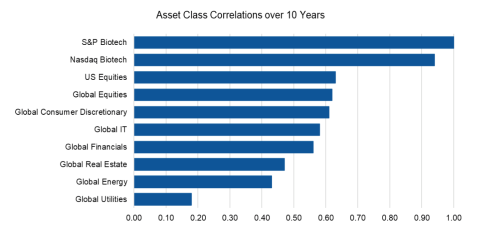
Source: Franklin Templeton Capital Market Insights Group, S&P Dow Jones Indices, 15 March 2021. Bloomberg. Data from Jan 2010 to Dec 2020. All returns in USD. S&P Biotech refers to S&P Biotechnology Select Industry TR USD. Nasdaq Biotech refers to NASDAQ Biotechnology TR USD. US Equities refer to S&P 500 TR USD. Global Equities refer to MSCI World GR USD. Global Consumer Discretionary refers to MSCI World/Consumer Disc GR USD. Global IT refers to MSCI World/Information Tech GR USD. Global Financials refers to MSCI World/Financials GR USD. Global Real Estate refers to FTSE EPRA NAREIT Developed TR USD. Global Energy refers to MSCI World/Energy GR USD. Global Utilities refer to MSCI World/Utilities GR USD. Indexes are unmanaged, and one cannot invest directly in an index.
A practical way to see the benefits of this lower correlation is to include Biotechnology into possible allocations and see if there are indeed any improvements in terms of risk and return characteristics.
Referring to Chart 2 below, the volatility of a typical core equity allocation can be reduced via a 10% allocation to Biotechnology. Over the last 10 years, the volatility and maximum drawdown of the S&P 500 (Light Blue Shade) is improved by allocating 10% to Biotechnology (Dark Blue Shade).
A similar observation can be seen in the volatility of a traditional 60% Equity 40% Bond allocation (Light Green Shade). A 10% allocation to Biotechnology (Dark Green Shade) gives the investor a better return per unit of risk. In addition, the maximum drawdown profile is also more favorable.
Chart 2: Inclusion of the S&P Biotechnology Select Industry Index has helped enhance the overall performance of core equity and traditional portfolios over the last 10 year
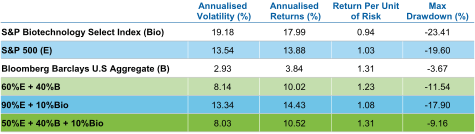
Sources: Franklin Templeton Capital Market Insights Group, S&P Dow Jones Indices, Bloomberg Barclays. 15 March 2021. Data from Jan 2010 to Dec 2020. Index performance based on monthly total return in USD. Table shown is provided for illustrative purpose and reflects hypothetical historical performance. Past performance is not necessarily indicative nor a guarantee of future performance. Indexes are unmanaged, and one cannot invest directly in an index.
In addition to its diversification benefits, valuation of Biotech is currently attractive (Chart 3); coming in at the low end of its 10-year differential when compared to the broader U.S. equity market.
Chart 3: Biotechnology Stocks Look Compelling Compared to the Broader US Market
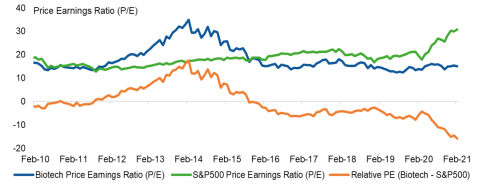
Source: Bloomberg, 15 March 2021. Data ending 28 February 2021. STANDARD & POOR’S®, S&P® and S&P 500® are registered trademarks of Standard & Poor's Financial Services LLC. Standard & Poor's does not sponsor, endorse, sell or promote any S&P index-based product. Past performance is not necessarily indicative nor a guarantee of future performance. Biotech index refers to the S&P Biotechnology Select Index. Indexes are unmanaged, and one cannot invest directly in an index.
The bottom line
The value and performance of biotechnology companies are largely driven by individual company events such as clinical trial results, regulatory approvals, and drug sales, and much less affected by general economic conditions. This divergence of business path and market sentiment offers investors a time-tested opportunity of diversification while still being invested in equities.
WHAT ARE THE RISKS?
This document is for information only and does not constitute investment advice or a recommendation and was prepared without regard to the specific objectives, financial situation or needs of any particular person who may receive it and does not constitute legal or tax advice. This document may not be reproduced, distributed, or published without prior written permission from Franklin Templeton.
Any research and analysis contained in this document has been procured by Franklin Templeton for its own purposes and may be acted upon in that connection and, as such, is provided to you incidentally. Data from third party sources may have been used in the preparation of this document and Franklin Templeton has not independently verified, validated, or audited such data. Although information has been obtained from sources that Franklin Templeton believes to be reliable, no guarantee can be given as to its accuracy and such information may be incomplete or condensed and may be subject to change at any time without notice. Any views expressed are the views of the portfolio manager as of the date of this document and do not constitute investment advice. The underlying assumptions and these views are subject to change based on market and other conditions and may differ from other portfolio managers or of the firm as a whole. The mention of any individual securities should neither constitute nor be construed as a recommendation to purchase, hold, or sell any securities, and the information provided regarding such individual securities (if any) is not a sufficient basis upon which to make an investment decision. The information provided in this material is not intended as a complete analysis of every material fact regarding any country, region, or market. There is no assurance that any prediction, projection or forecast on the economy, stock market, bond market or the economic trends of the markets will be realized. Franklin Templeton accepts no liability whatsoever for any direct or indirect consequential loss arising from the use of any information, opinion or estimate herein and reliance upon the comments, opinions, and analyses in the document is at the sole discretion of the user.
The value of investments and the income from them can go down as well as up and you may not get back the full amount that you invested. Past performance is not necessarily indicative nor a guarantee of future performance.
Products, services, and information may not be available in all jurisdictions and may be offered by other Franklin Templeton affiliates and/or their distributors as local laws and regulation permits. Please consult your own professional adviser for further information on availability of products and services in your jurisdiction. This is not an offer to sell or a solicitation of an offer to purchase securities in any jurisdiction where it would be illegal to do so.