
Evolving demographics
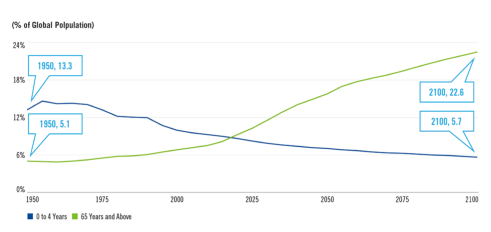
For the next 80 years, global population is projected to increase gradually until we peak-out at 10 billion by 21001. While the persistent existence of our species is good news, the underlying data paints a concerning picture. The global replacement rate (infants born to replace lives lost) is slowing down while the mortality rate of the world is decreasing. By 2100, almost one in four people will be 65 years old or older, while one in 20 will be younger than five [Chart 1]. To compound this inversion, the elderly is expected to live longer aided by increased access to medical expertise, advancement of medical technology and better/more stable living conditions when compared to 100 years ago2.
An increased global population, greying demographics and longer life expectancy are very recent developments which created an incredible demographic tsunami that has implications throughout the socioeconomic fabric of the world.
Chart 1: Fewer youth, more elderly
Source: United Nations, Department of Economic and Social Affairs, Population Division (2019). World Population Prospects 2019
I think the biggest innovations of the 21st century will be at the intersection of biology and technology. A new era is beginning.
The New Era Of Biotechnology
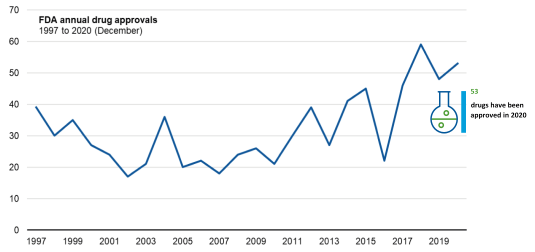
As a society, we are finally beginning to reap the benefits of the many scientific and medical advancements made in the past 10-15 years, all of which have led to the recent surge in novel drugs and treatment modalities. In fact, the last several years have seen consistently large numbers of novel new therapies approved, and 2020 was another strong year [Chart 2]. Recent advances in genomics and proteomics, as well as in DNA sequencing technologies, have enabled a more informed and targeted approach to designing drugs. Compared to a decade ago, the time-to-market for new drugs has become both quicker and generally more predictable. This is due to advancements in both pre-clinical and early-stage development work that can be used to better understand a drug’s mechanism of action, potential safety liabilities, and the most suitable patient population in which to demonstrate efficacy.
Chart 2: New Drug Innovation Remains the Key to Biotech Sector Growth
Source: Food and Drug Administration’s (FDA) Center for Drug Evaluation and Research (CDER). As of 30 December 2020.
Advancements In Oncology And Gene Therapy
Specifically, recent advancements made in the areas of oncology and gene therapy are creating medical solutions never before available.
Oncology is a branch of medicine that deals with the prevention, diagnosis, and treatment of cancer. Advancements in both immuno-oncology (IO) and precision oncology have opened new pathways for treating patients. IO is a therapeutic approach that harnesses the power of a patient’s own immune system to fight cancer. IO is being used for the treatment of different cancers such as lung, liver, pancreas and cervical. Precision oncology (also known as targeted oncology) is another promising area in oncology that aims to improve outcomes by personalizing the treatment strategy for each cancer patient. This type of medical solution is being used to treat, amongst others, leukemia and lymphoma.
Gene therapy is a decades-old idea that is finally becoming medically feasible, due to recent advancements that have made it safer and more effective. Gene therapy involves the viral delivery of new genetic material into a patient’s cells to correct a missing or defective disease-causing gene in the body. The advantage of gene therapy is that it is designed to be a disease-modifying one-time treatment that would ideally cure a patient for life, rather than chronically treating their symptoms. This currently being applied to a variety of rare and devastating genetic disorders, such as spinal muscular atrophy.
The COVID-19 Response
A perfect example of how innovation is driving rapid drug development is the biopharma industry’s response to the COVID-19 pandemic. The entire industry mobilized almost immediately in response to this global emergency, and companies around the world have managed to leverage their innovative drug/vaccine discovery platforms and move candidates into human testing an unprecedented pace.
Remarkably, drug developers have managed to condense the development timelines for these drugs and vaccines to a matter of months, whereas under normal circumstances it would typically take several years from start to finish. We have seen significant progress in this space, and we are optimistic that we will have at least one (if not more) effective and safe vaccine in the near term. There are three areas which medical development have helped support the fight against COVID-19.
Firstly, antiviral drugs are designed to reduce viral load by preventing the virus from replicating or making copies of itself. Thus far, one antiviral, remdesivir, has been shown to be effective in randomized studies. The FDA granted remdesivir Emergency Use Authorization (EUA) on May 1, 2020, and full FDA approval in later in October3.
Aside from antivirals, there are multiple drugs in development to address the symptoms associated with COVID-19 infection. These drugs will likely be used in combination with antivirals. Examples of supportive care drugs include anti-inflammatory drugs which are used for treating the overactive immune response, when combating the COVID-19 infection.
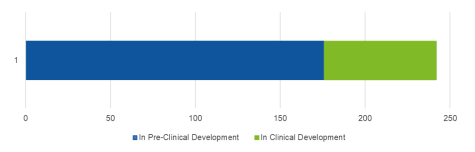
Antiviral and supportive care drugs alone are not sufficient to end the pandemic. There is still a need for a vaccine to prevent future infections and help generate herd immunity. The pipeline for COVID-19 vaccines is evolving and expanding at an unprecedented pace. Currently, there are over 240 vaccine candidates in various stages of development; most are early and still in pre-clinical development [Chart 3]. Many of these candidates are based on novel technologies developed by new entrants with limited vaccine experience. That said, several established vaccine developers have candidates based on the more tried-and-true vaccine technologies are already in or about to enter human trials.
Chart 3: No lack of candidates for a vaccine against COVID-19
Source: World Health Organization. Landscape of novel coronavirus candidate vaccine development worldwide. 12 February 2021.
The Bottom Line
Biology is harnessing technological leaps in cellular and biomolecular processes to develop expertise and products that help improve our lives and the health of our planet. Recent advancements in areas such as faster data processing, cloud computing, machine learning, and artificial intelligence is paving way for a fusion of biology and technology. The medical dividends are already transformative while investment opportunities will most likely increase.
ENDNOTES
-
United Nations, Department of Economic and Social Affairs, Population Division (2019). World Population Prospects 2019.
-
Decade of healthy ageing: baseline report. Geneva: World Health Organization; 2020. 14 January 2021
-
United States Food & Drug Administration Press Release; Coronavirus (COVID-19) Update: FDA Issues Emergency Use Authorization for Potential COVID-19 Treatment, 1 May 2020. FDA Approves First Treatment for COVID-19, 22 October 2020.
WHAT ARE THE RISKS?
This document is for information only and does not constitute investment advice or a recommendation and was prepared without regard to the specific objectives, financial situation or needs of any particular person who may receive it and does not constitute legal or tax advice. This document may not be reproduced, distributed, or published without prior written permission from Franklin Templeton.
Any research and analysis contained in this document has been procured by Franklin Templeton for its own purposes and may be acted upon in that connection and, as such, is provided to you incidentally. Data from third party sources may have been used in the preparation of this document and Franklin Templeton has not independently verified, validated, or audited such data. Although information has been obtained from sources that Franklin Templeton believes to be reliable, no guarantee can be given as to its accuracy and such information may be incomplete or condensed and may be subject to change at any time without notice. Any views expressed are the views of the portfolio manager as of the date of this document and do not constitute investment advice. The underlying assumptions and these views are subject to change based on market and other conditions and may differ from other portfolio managers or of the firm as a whole. The mention of any individual securities should neither constitute nor be construed as a recommendation to purchase, hold, or sell any securities, and the information provided regarding such individual securities (if any) is not a sufficient basis upon which to make an investment decision. The information provided in this material is not intended as a complete analysis of every material fact regarding any country, region, or market. There is no assurance that any prediction, projection or forecast on the economy, stock market, bond market or the economic trends of the markets will be realized. Franklin Templeton accepts no liability whatsoever for any direct or indirect consequential loss arising from the use of any information, opinion or estimate herein and reliance upon the comments, opinions, and analyses in the document is at the sole discretion of the user.
The value of investments and the income from them can go down as well as up and you may not get back the full amount that you invested. Past performance is not necessarily indicative nor a guarantee of future performance.
Products, services, and information may not be available in all jurisdictions and may be offered by other Franklin Templeton affiliates and/or their distributors as local laws and regulation permits. Please consult your own professional adviser for further information on availability of products and services in your jurisdiction. This is not an offer to sell or a solicitation of an offer to purchase securities in any jurisdiction where it would be illegal to do so.