
For decades, the word "risky" has been practically glued to "emerging markets" in investment conversations. It's become so automatic that most investors don't even question it anymore. But what if that assumption is completely outdated?
Let's talk about risk honestly—not with scary stories from the 1990s, but with the data from today's markets. When you dig into the numbers, the "risky emerging markets" narrative starts falling apart in three specific ways.
Risk #1: The Stability Question
The old belief: Emerging markets are unstable with weak institutions and unpredictable policy.
The reality: That ship has sailed—about two decades ago.
Today's emerging markets have fundamentally transformed their macro-stability profiles. We're not talking about marginal improvements; we're talking about a complete overhaul. Most major emerging economies now operate with macro indicators that match or even exceed their developed market counterparts.
Here's what changed: Countries learned from brutal past crises and built robust frameworks. They accumulated massive foreign exchange reserves as insurance policies. They adopted formal inflation-targeting frameworks identical to what the US Federal Reserve and European Central Bank use. They practice fiscal discipline even when it hurts politically.
Perhaps more importantly, the emerging markets equity universe is now concentrated in countries with mature capital markets and established corporate governance frameworks. The Wild West days of opaque accounting and shareholder exploitation? Increasingly rare. The risk of large-scale governance disasters has dropped dramatically.
Translation: The institutional instability that haunted emerging markets in the past is largely gone. These aren't shaky economies anymore—they're sophisticated systems operating with developed-market discipline.
Risk #2: The Drawdown Fear
The old belief: Emerging markets can crash spectacularly with massive drawdowns that wipe out your investment.
The reality: While any equity investment carries drawdown risk, emerging markets actually offer a cushion right now.
Here's the counter-intuitive part: Current valuations for emerging market equities are relatively low compared to developed markets although emerging markets are trading above their historical average. In other words, there's less air in the balloon.
Discount to 5-Year Peak by Market
8 out of the 10 markets trading furthest below their five-year highs are EM
Five-year period ending 27 Feb 2026
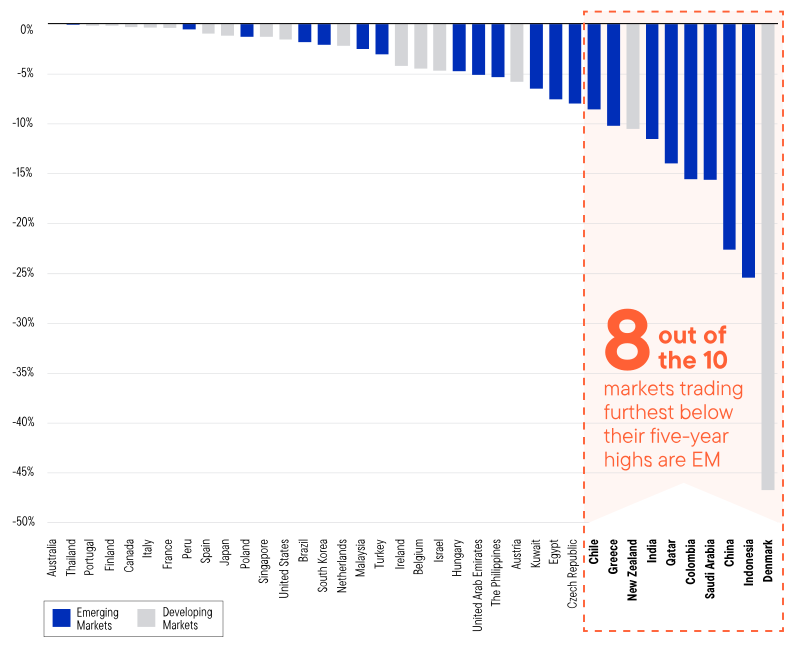
Source: MSCI. Bloomberg, Franklin Templeton
Think about what that means from a risk perspective. When you buy something that's already at its all-time high, the asymmetry isn't in your favour. But when you're buying below five-year highs with improving fundamentals? The math starts looking different.
Yes, emerging markets saw a broad rally recently. But they're rallying from depressed levels toward reasonable valuations—not from expensive levels toward bubble territory.
Translation: The "catastrophic drawdown" risk actually looks higher in overstretched developed markets than in emerging markets trading at more attractive entry points.
Risk #3: The Volatility Reality
The old belief: Emerging markets are wild roller coasters compared to the steady ride of developed markets.
The reality: The volatility gap has completely closed.
This is where the data gets really interesting. If you look at rolling one-year annualized volatility for both developed markets (MSCI World) and emerging markets (MSCI Emerging Markets), they're essentially identical now—and both are near historical lows.
Let's break down how dramatically this has shifted:
2001-2010:
- Emerging Markets average volatility: 22%
- Developed Markets average volatility: 14%
- Difference: 8%
2011-2020:
- Emerging Markets: 16%
- Developed Markets: 12%
- Difference: 4%
2021-2025:
- Emerging Markets: 15%
- Developed Markets: 15%
- Difference: 0%
Source: MSCI, Bloomberg, Franklin Templeton
Read that again: zero difference. Emerging markets are no longer more volatile than developed markets. That premium you thought you were taking on by investing in emerging markets? It doesn't exist anymore, at least not from a volatility standpoint.
Translation: The "wild and unpredictable" characterisation is statistically false. Today's emerging markets behave like developed markets in terms of volatility but offer better growth prospects.
The Big Picture
When you examine risk through these three lenses—macro stability, drawdown potential, and volatility—the traditional narrative crumbles.
Emerging markets have:
- Institutional maturity rivaling developed markets
- More attractive valuations offering better risk/reward asymmetry
- Volatility profiles identical to developed markets
So why does the "risky emerging markets" myth persist? Because narratives take time to die—especially when they've been repeated for generations. But the facts have moved on, even if the conventional wisdom hasn't caught up yet.
In 2026, the real risk might not be investing in emerging markets. It might be allocating based on outdated assumptions while the world quietly changes around you.
Key Takeaway: Risk isn't binary—it's about understanding what you're actually getting for the risk you're taking. Today's emerging markets offer developed-market stability with emerging-market growth potential. That's not a risky proposition. That's a compelling one.
Make emerging markets a continuous conversation
Markets don’t stand still—and neither does our thinking. Join a growing community of investors who receive our latest emerging markets research, data-driven insights, and evolving views as global conditions change.